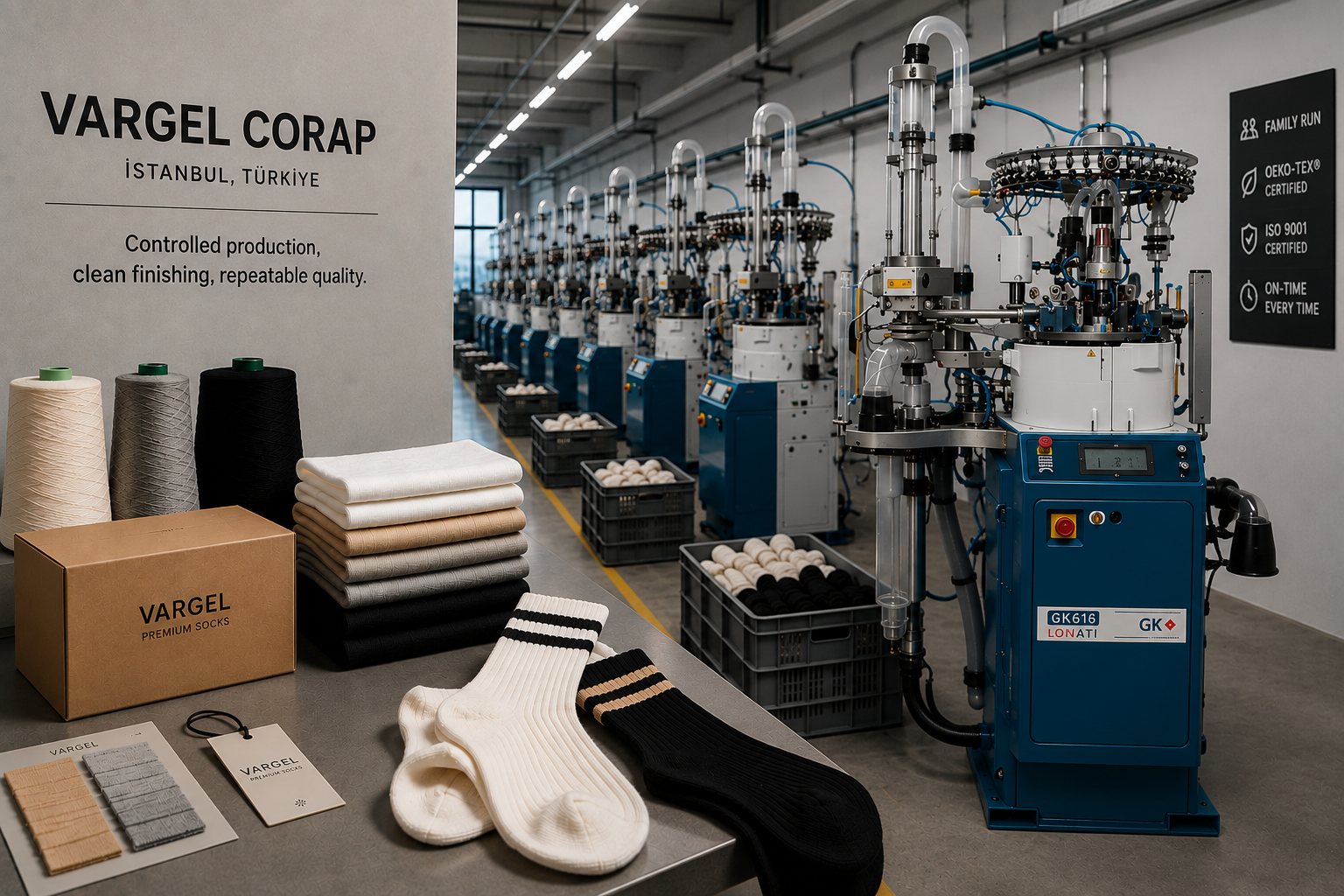
From yarn selection to export cartons — a transparent look at every stage inside our Istanbul factory. More about us as a socks manufacturer in Turkey →
Combed and organic Turkish cotton, bamboo viscose, merino blends and technical fibers — sourced from certified spinners and lot-tested on arrival.
Electronic circular knitting machines (84–200 needle) produce everything from chunky terry boot socks to fine-gauge dress socks, with jacquard logos knitted directly into the fabric.
Hand-linked or seamless rosso toe closure — the detail that separates a premium sock from a supermarket sock.
Steam boarding gives each sock its final shape and size consistency; pairs are matched and inspected one by one.
Custom labels, wraps, hang tags, boxes or polybags — retail-ready and barcode-compliant for chains and marketplaces.
AQL-based sampling inspection, metal detection on request, then export documentation and freight booking (EXW / FOB / DAP).
Electronic single-cylinder and double-cylinder knitting machines in 84 to 200 needle counts, supporting terry, rib, jacquard, mesh and cushioned constructions.
Baby (16-18) through adult (47-50), with graded sizing charts per market — EU, UK and US conversions handled by us.
Combed cotton, GOTS organic cotton, bamboo viscose, merino wool, Coolmax®-type technical yarns, recycled polyester, lycra and elastane.
Knitted-in jacquard logos, 3D cushioning zones, compression zones, hand-linked toes, anti-slip silicone printing, embroidery.
Quality is checked at four gates: incoming yarn, in-line knitting, post-boarding and pre-shipment AQL inspection. Every export order leaves with a signed inspection report. The yarns we knit with carry OEKO-TEX® Standard 100 certificates from their spinners, and we hand those over with the order file. We are not ISO 9001 audited — the workflow above is our own, documented and open to your inspection.
Most buyers never see this, and it matters more than any brochure claim — because every quality problem you can have with a sock is created at one of these steps.
Knits in one direction. Covers most everyday, sports and dress socks and handles jacquard colourwork well. Faster, so it is the economical choice when the construction does not demand more.
Transfers stitches between two cylinders, which is what makes genuine rib and links-links structures possible. Slower and more expensive per pair, but there is no way to fake the result on a single-cylinder machine.
We run both. That matters because a factory with only one type will steer your design toward what its machines can do, and you will not be told that is what happened. If your sock needs a true rib, you should hear it from the factory rather than discover it in the sample.
"Quality control" means nothing without saying where and what. Ours is four checkpoints, and each catches a different class of problem:
| Gate | What is checked | What it prevents |
|---|---|---|
| 1 · Incoming yarn | Certificate, dye lot, count, hand-feel | Colour mismatch between cartons; unverified fibre claims |
| 2 · In-line knitting | Live inspection during the run | A machine fault ruining a whole batch before anyone notices |
| 3 · Post-boarding | Every sock, individually | Holes, dropped stitches, bulky toe seams, size drift |
| 4 · Pre-shipment AQL | Statistical sample before cartons close | Packing, labelling and count errors reaching your warehouse |
You are welcome to audit any of this, or send a third-party inspector. See what we certify and how to audit us.
Send your tech pack or just a sketch — first sample in 2–7 days.
Request a quote